What a Commercial Boiler Service Looks Like for a Cork School: A Case Study at Scoil Mhuire Ballincollig

Maintaining a school building is enough of a challenge without having to worry about the heating system failing when the temperature drops. This case study looks at a recent project at Scoil Mhuire Ballincollig, where we serviced a high-output Buderus SE425 boiler, ensuring the system was safe and efficient for the busy winter term. By taking a closer look at the actual steps involved, from cleaning the internal components to testing the safety controls, we show how a proactive service prevents the disruption of emergency closures and keeps energy costs under control. Read on to see exactly what a professional commercial boiler service involves for a Cork school.

Buderus SE425 Commercial Boiler Service for a Cork School: What the Job Actually Involves

Schools in Cork rely on their heating more than almost any other type of building. When a boiler stops working in the middle of winter, it is not just an inconvenience. It can mean closing the school, sending pupils home, and dealing with a stressful and expensive emergency repair. That is a situation every school manager wants to avoid. At GES Ireland, we carry out commercial boiler servicing across Cork City and County. In this post, we want to walk through a real job we completed at a school in Cork so you can see exactly what is involved, what we look out for, and why keeping on top of it matters.

The School and the Boiler: A Case Study at Scoil Mhuire Ballincollig

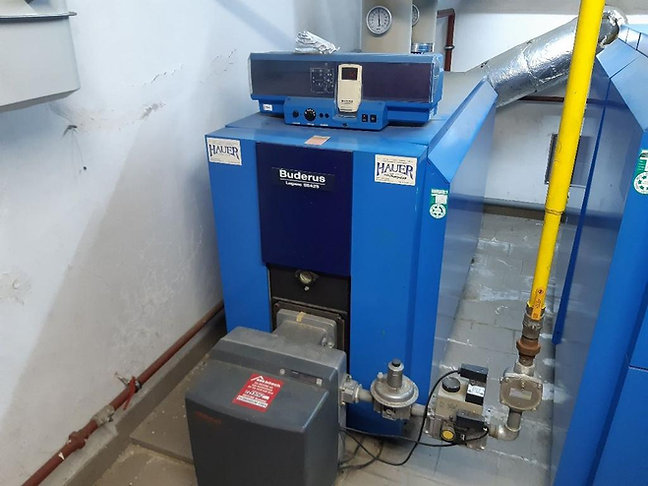
The project at Scoil Mhuire Ballincollig involved a Buderus SE425 commercial boiler, which is a floor-standing unit running on natural gas. The boiler was in the 110 to 140 kW output range, which puts it firmly in the commercial category. This is the kind of unit found in larger educational facilities with a serious heating demand, and it needs to be properly maintained to perform reliably. Before we arrived, the school had flagged a few concerns. The building felt harder to heat than it used to, and the boiler seemed to be working more than it should for the results it was delivering. This is a common sign that something is not quite right, and it provided a clear reason to perform a full, professional service.
What We Found When We Arrived

When we looked over the installation before starting the service, a couple of things stood out.

The first was the pipework. In older school buildings, the pipes connected to the boiler were not always sized with a unit this size in mind. Undersized pipes restrict how well the system can circulate water, which puts extra strain on the boiler and reduces how effectively heat gets distributed around the building. This was something we needed to flag and address.

The second issue was around the flue and ventilation. A commercial boiler at this output level needs a good air supply to burn fuel cleanly and a properly functioning flue to remove the waste gases safely. When either of those is not right, the boiler cannot do its job properly. In this case, the ventilation needed attention, and it was a likely contributor to the inefficiency the school had been noticing.

Both of these are the kind of issues that build up gradually. They do not usually cause an immediate breakdown, but over time they mean the boiler is burning more fuel to produce less heat. For a school that is heating a large building every weekday through the winter, that adds up.

How the Service Day Went

The full service took around three to four hours from start to finish. We scheduled it at a time that worked for the school to keep disruption to a minimum. The boiler needed to be shut down for the duration of the work, so we planned the timing carefully with the school’s facilities team.

Here is what we worked through on the day.

Starting with a full inspection.

Before touching anything, we did a thorough visual check of the boiler, the plant room, the pipework, and the flue. We are looking for anything that does not look right before we open anything up, and it gives us a good picture of the overall condition of the system.

Cleaning the burner and heat exchanger.

This is one of the most important parts of any commercial boiler service. Over time, carbon deposits and soot build up on the burner and the heat exchanger surfaces. When those surfaces are dirty, the boiler has to work harder to transfer heat into the system. Cleaning them properly brings efficiency back up, often noticeably so.

Combustion testing.

We use calibrated equipment to measure how the boiler is burning fuel. This tells us whether the air-to-fuel ratio is correct, how efficiently it is running, and whether there are any safety concerns around what is coming out of the flue. If adjustments are needed, we make them to bring everything back to where it should be. This step has a direct impact on running costs as well as safety.

Testing all the safety controls.

The high-limit thermostat, the pressure relief valve, the gas valve, and the sensors are all tested to confirm they are working correctly. These are the components that protect the boiler and the building if something goes wrong, so making sure they are in good order is not something we skip over.

Checking the flue and ventilation.

We checked the flue for any blockages or deterioration and confirmed the ventilation openings were adequate for the boiler’s output. Where we found issues, we documented them clearly and discussed next steps with the school.

Looking at the wider system.

As well as the boiler itself, we checked the water pressure, the pump, and the condition of the pipework. Where the pipe sizing was a concern, we noted this in the report so the school has a clear picture of what may need attention going forward.

Writing up the report.

At the end of the visit, we put together a full written service report covering everything we inspected, tested, and cleaned. It includes the combustion analysis results, any issues we found, and our recommendations. Schools should keep this on file as part of their maintenance records, and it is something insurers and inspectors may ask to see.

Why This Matters for Cork Schools

A commercial boiler that is not serviced regularly does not just become less efficient. It becomes less reliable. Small problems that could be caught and fixed during a service turn into bigger problems that are harder and more expensive to deal with.

For schools, the timing of a breakdown matters enormously. A boiler that fails on a cold Monday morning in January means a closed school, disrupted teaching, and an emergency call-out that will cost significantly more than a planned annual service. Staying on top of maintenance is genuinely the more affordable option, not just the more responsible one.

There is also the running cost to consider. A boiler working at reduced efficiency because it has not been cleaned or tuned is spending more fuel to deliver the same heat. Over a full heating season in a school-sized building, that is a real and measurable cost. A proper annual service pays for itself.

Read More: Thinking Big? Why Top-Notch Commercial Plumbing is Non-Negotiable for Your Cork Business

What to Expect If You Book With Us

If you manage a school in Cork and you want to get your commercial boiler serviced, here is what the process looks like with GES Ireland.

We will discuss the boiler make, model, and fuel type with you in advance so we arrive prepared. We agree a time that suits the school and causes the least disruption. The boiler will be shut down for the duration of the service, typically three to four hours. At the end, you receive a written report that documents everything and gives you a clear picture of the condition of your system. All our gas work is carried out by a Registered Gas Installer. We are also SEAI-registered and Safe Electric-certified. We have been working with schools and commercial premises across Cork City and County for over 20 years.

If you want to talk through your boiler or book a service, give us a call or send us a message.

Frequently Asked Questions

How often should a school get its commercial boiler serviced?

Once a year is the standard recommendation for commercial boilers in school buildings. The best time to schedule it is in late summer or early autumn, before the heating season begins. That way, any issues are caught and sorted before the boiler is needed every day through winter. Leaving it until something goes wrong is always the more expensive option.

Who is allowed to service a commercial gas boiler in Ireland?

All gas work in Ireland, including boiler servicing, must be carried out by a Registered Gas Installer. This is a legal requirement that applies to commercial premises as well as homes. Before booking a contractor, always ask to see their RGII registration. GES Ireland are fully registered and can provide details on request.

What does a commercial boiler service include?

A full service covers a visual inspection of the boiler and plant room, cleaning of the burner and heat exchanger surfaces, combustion analysis and adjustment, testing of all safety controls, a check of the flue and ventilation, and a written service report. The specifics depend on the boiler model and fuel type, but all of these elements should be part of any thorough service.

What are the signs that a school boiler needs attention?

The most common signs are higher fuel bills without any obvious reason, the building taking longer to heat up, the boiler making unusual noises, the pressure dropping regularly, or the boiler cutting out and needing to be reset. Any of these are worth acting on rather than waiting for the annual service date.

How long does a commercial boiler service take in a school?

For a unit like the Buderus SE425 in the 110 to 140 kW range, a full service typically takes between three and four hours. We work with schools to schedule the visit at a time that keeps disruption to a minimum, and we communicate clearly in advance so the facilities team knows what to expect on the day.